
Finding Your Cheapest Electricity Tariff from Your Smart Meter Data
In Ireland there are more than 1.9 million smart electricity meters installed yet only a small number of us use what would be the best (i.e. cheapest) electricity tariff for us. Smart meters can mean an increase in your electricity bills, or they can mean a reduction in your electricity bills but the challenge is having to blindly choose what will probably be the wrong supplier and the wrong electricity tariff for you, from almost 60 tariffs available from a dozen energy suppliers.
You can look at the annual standing charge, you can look at the peak rate, or the day and the night rates, or you can check the % discount on offer, or you may be tempted by a welcome discount, or maybe the EV rate if you charge at home, or even the FIT rate if you have solar panels or maybe you just like that you will get entered for a draw for tickets to some event and from all that, you have to choose a tariff.
Even taking all of these factors together does not help you choose what will be the cheapest electricity tariff for you. The only way to find what is your cheapest tariff -- and it might be a smart tariff, a day/night rate or a fixed 24 hour rate -- is to use your own smart meter data.
Is it worth bothering to find the cheapest tariff ?
Several thousands of people have used our system and as of February 2026, the cheapest annual bill averaged just under €1,072 while the most expensive averaged €2,007. That's a difference of almost €1,000 a year for the same household, the same energy used, just by choosing the right or the wrong tariff !
To make finding your cheapest tariff even more complex there is one tariff which is the cheapest from among 60 tariffs, for more than 92% of us, and there is another tariff which is by far the most expensive for more than 32% of us.
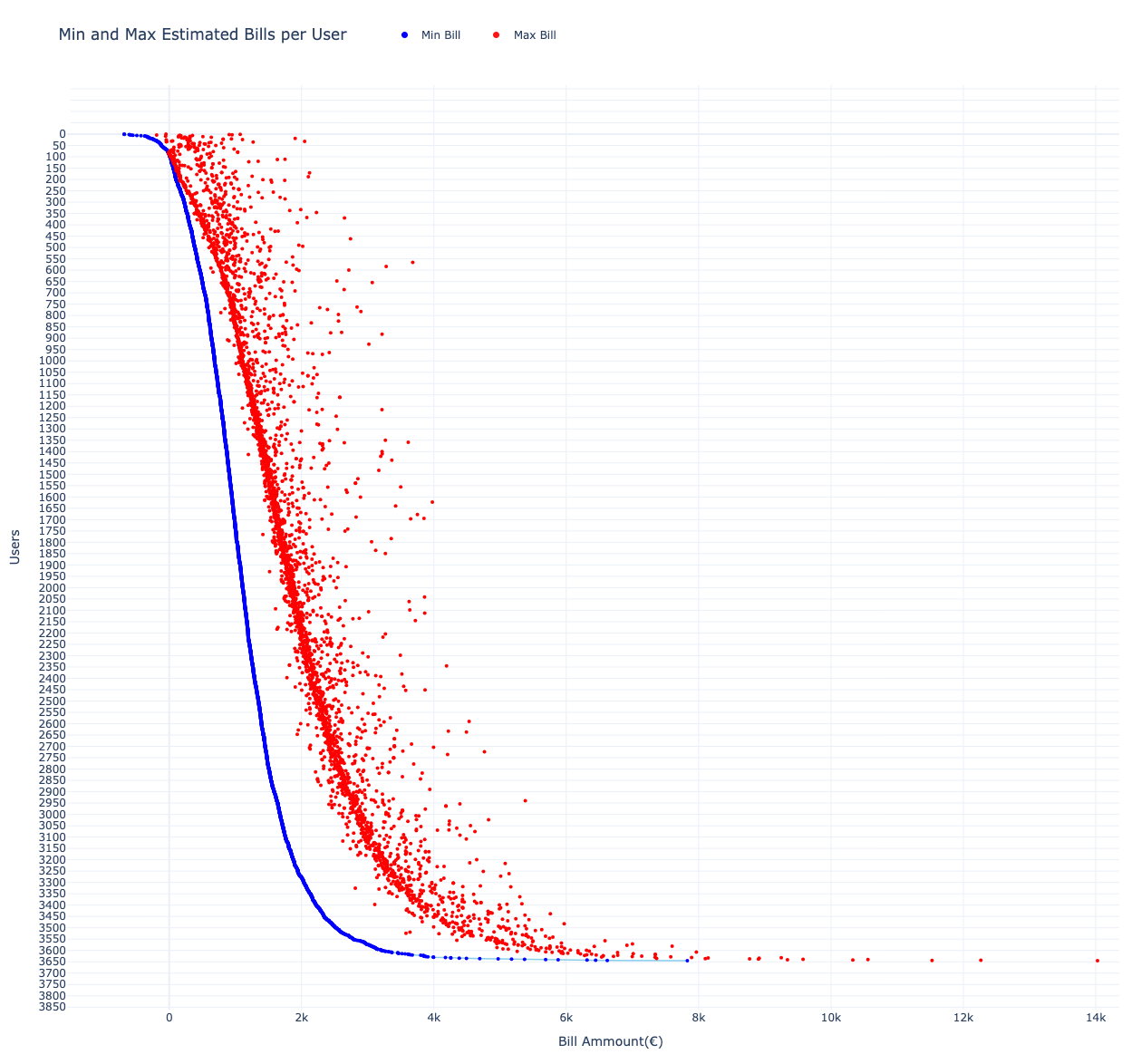
The graph below shows the cheapest and most expensive of the currently available tariffs for a sample of more than 3,600 domestic consumers ... blue dots are their cheapest smart tariffs, red dots are their most expensive. Look at the gap, the horizontal distance between the cheapest (blue dot) and most expensive (red dot). There is one household in there that could be paying anything between €1,750 and €5,500 per year and remember, these are from the same households (click on the graph to enlarge it).

Below is the link to a Google form for calculating your electricity bill from your data. To use it you will need your MPRN number which you can find on your electricity bill, and an email address as a place we can email your results.

Good luck, we hope this saves you some money.
Any questions, please contact Alan Smeaton
May 2026
Show Me How To Use It
Here's a link to a YouTube video from 2024 showing how our system works and what the output and savings are for a typical user.
Media Coverage
The Law Society Gazette reported on the CCPC registering the first 'data-altruism' body, DCU's Elec-tariffs.ie, an Insight project by Prof Alan Smeaton, Shuxiang Cai (now DTS) and Xianjuan Chen. "CCPC registers first 'data-altruism' body" (5 February 2026).
TechCentral also reported it "CCPC registers Elec-tariffs.ie as first data altruism organisation" (6 February 2026) as did the Irish Legal News "Energy website registered as first Irish data altruism organisation" (6 February 2026).
Here's the link to the EU register of recognised data altruism organisations: https://digital-strategy.ec.europa.eu/en/policies/data-altruism-organisations.
Joanne Hunt wrote on "Most Irish households aren't using smart meters properly. Doing so could save you €800" (17 September 2025).
Gabrielle Monaghan of the Sunday Independent wrote on "How I used smart meter data to cut my electric bill by €500", Sunday Independent and Independent Money Hub (13 July 2025).
Alan Smeaton was interviewed on RTÉ Radio One Today with Claire Byrne show on the topic of "Electricity update: how to make savings with your smart meter" (19 June 2025).
Alan Smeaton was interviewed on RTÉ Radio One Today with Claire Byrne show on the topic of "How to get the best value electricity tariffs using your smart meter" (13 June 2025).
FAQs
Q: What do you do with our anonymised smart meter data ?
A: We use it to more accurately predict energy usage for others, the same as we use data from others for estimating yours. We also make some of the anonymised usage data publicly available in order to benefit the community and society and to add to the body of scientific research in the area of energy usage. You can see some of this anonymised data here and a larger dataset consisting of 5,100 years, 10 months, 27 days, and 6 hours of anonymised smart meter data from 2,990 consumers is available here.
Q: Why are you doing this, what's in it for you ?
A: We do not have any fee, there is no kickback from any of the suppliers, we don't ask for donations, we are doing this because we are interested in what data from smart meters can be used for.
Q: Who funds this ?
A: This work is supported by the Insight Research Centre for Data Analytics at Dublin City University, funded by Research Ireland.
Q: You are an accredited Data Altruism Organisation ... what is that ?
A: In February 2026 the Competition and Consumer Protection Commission (CCPC) registered Elec-tariffs.ie operated by Dublin City University as Data Altruism Organisation (DAO) under the EU Data Governance Act (DGA). We are the first Data Altruism Organisation registered in Ireland and just the 4th DAO registered in Europe (see press release).
Q: Who are you ?
A: Alan Smeaton is Professor of Computing at Dublin City University and Xianjuan Chen and Shuxiang Cai are researchers who worked on this project. The entity behind this work is Elec-tariffs.ie operated by Dublin City University. Dublin City University is a registered charity with the Charities Regulatory Authority, RCN 20013653.
What Others Say
In April 2026 this work was nominated for a DCU President's Impact award. We didn't win but we would like to share a summary of some of the feedback comments that many of our users provided for our nomination.
We used the DCU Enterprise version of Gemini with the Pro setting to summarise the key findings from 341 anonymous responses to an online Vevox poll of users where we asked them to provide an indication of the impact elec-tariffs.ie had on them.
Below are the three key findings from Gemini's analysis.
1. Delivered Tangible Economic Relief to Families
The research moved beyond theoretical analysis to provide immediate financial benefit for households. By decoding complex energy consumption data, the tool neutralized the "minefield" of confusing tariffs, directly putting hundreds of euros back into the pockets of families' particularly those with high energy needs (EVs, Heat Pumps) who were previously underserved by standard comparison sites.
2. Restored Public Trust in Energy Decision-Making
In an environment defined by skepticism toward commercial entities and "confusing advertising," this research successfully established the university as a trusted, independent civic partner. The online tool provided a "safe haven" for consumers, offering transparent, unbiased analysis that empowered them to make decisions without fear of hidden agendas or sales commissions.
3. Shifted the Power Balance from Utility to Consumer
The research fundamentally altered the consumer-provider relationship. By transforming raw, incomprehensible Smart Meter data into actionable intelligence, it granted "agency to the individual." Users reported moving from a state of anxiety and confusion to one of confidence, enabling them to challenge suppliers and negotiate better deals on equal footing.
By the Numbers: Validated User Savings
- €1,100: The highest reported annual saving by a single household (using EV, Heat Pump & Solar).
- €200 - €400: The typical annual saving range reported by standard households.
- 30%: The reduction in total energy costs reported by users after switching based on recommendations.
- Zero: The cost to the consumer for the analysis.
- 100%: The accuracy rate reported by users who cross-referenced the tool's calculations against their own manual spreadsheets.
What some of the responses actually said:
On Research Impact & Civic Duty:
"This project is a practical application of research to the lives of the public... I feel this is sadly rare in my experience but I have found it excellent."
On Restoring the Power Balance:
"It tips the balance back towards the ordinary household from the big energy companies who have the ability to analyse the data much better than the customer."
On Trust & Independence:
"I can highly trust and recommend elec-tariffs because they are honest, transparent and independent... I feel there is no ulterior motive behind the system."
On Clarity & Simplicity:
"Navigating so many different charges, rates and percentages makes selecting the correct tariff very difficult. This solution... filters out all of the noise."
 |
 |
 |
 |